

3 Examples of Successful Global Brand Localization
Localization means tailoring your content to your target market to reach more customers and grow your worldwide sales. Many companies sell their products and services in other countries, exporting and internationalizing. But not all of them do it in the same way or with the same conviction. For some, localizing is part of their strategy to connect with their customers; they’ve incorporated into their roadmap and made it part of their DNA. These companies know that the only way to sell is to connect with their customers first, and there is no better way to do that than by speaking to them in their own language and showing respect for their culture.
Here are three examples of localization from global brands that get it: they want to know where their customer is from, what language they speak, and what aspects of their culture they value.
1- Coca-Cola’s Phonetic Can Campaign: Bottles that Speak Your Language
The first example of global brand localization comes from Coca-Cola. Coca-Cola’s “Phonetic Can” campaign, launched in South Africa in November 2018 by the agency FCB Joburg (Pty) Ltd, was an integrated marketing campaign designed to promote intercultural understanding by including the phonetic transcription of various South African names on Coca-Cola cans, teaching people how to pronounce them. The campaign aimed to address social barriers caused by the country’s 11 official languages with a view to to bridging differences and fostering a sense of unity by making it easier for people to pronounce each other’s names. It was a great success, significantly boosting brand love and consumption, while also inspiring an array of user-generated content and its educational use in classrooms.
The Results
In 3 months, Coca-Cola had achieved the following:
- A 158% increase in brand love in a general context of decreasing love for soft drinks.
- A 27% increase in consumption of Coca-Cola Zero, the star product of the campaign.
- An overall year-on-year volume growth for Coca-Cola of 5.4%, in South Africa, where penetration exceeds 90%.
- 3.2 billion impressions: a 195% increase in engagement compared to the same period the year before, when an adapted global campaign was launched.

Lessons:
- Personalize at scale, but according to cultural codes (individual vs. collective).
- Appeal to universal emotions such as friendship.
- Encourage participation: consumers shared self-generated content.
2- LEGO: Localizing Everything from Packaging Strategies to Digital, Cultural, and Physical Content

The second example of global brand localization is from the Lego construction toy company. Since its humble origins, in Denmark, where it was founded in 1932 as a small wooden toy company, Lego has grown into a global powerhouse with over DKK 74.3 billion (about USD 10.8 billion) in revenue in 2024.
How did they do it? Some of the methods they use product localization, localized marketing, and event marketing. The Lego Group operates more than 1,000 Lego Stores around the world, from Germany to Japan, Brazil, or the United States.
Their products are also sold at other toy stores worldwide. Lego has always carefully selected and studied which markets to enter. Every Lego Store, anywhere in the world, has its own elements specific and localized to that particular market.
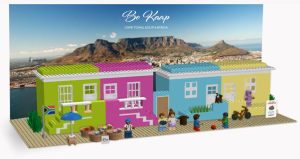
For example, the Lego store in Cape Town, South Africa, displays a model of the Bo-Kaap neighborhood built by a local hobbyist.
Lego doesn’t take its position as a global brand for granted and makes sure to tailor everything – from products and manufacturing to marketing – to each location.
The group’s flagship store in Beijing, China, features a clearly Chinese design, including details such as eaves reminiscent of the Forbidden City and a giant panda built with the unmistakable Lego bricks.

Lego has experienced steady growth in the Chinese market since entering the country more than two decades ago.
The brand opened its first retail store in Asia – and its largest globally – in Shanghai, in 2016, and followed up soon after with another, in 2018.
3- The Spotify Model: Localizing to Foster User Belonging

The third example of global brand localization comes from the music streaming platform Spotify.
Spotify localizes its platform in 74 languages to make users feel at home.
It is the world leader in music streaming, thanks to its wide range of songs and podcasts and excellent localization strategy. The platform has made its mark in 180 markets and attracted 615 million users. Founded in 2006 by two Swedish tech entrepreneurs, Spotify revolutionized how people access music, moving away from physical purchases and downloads to streaming.
Today, by making its platform available in so many languages, Spotify delivers an even more personalized experience, allowing users to access the service in their native or local language and pay in their local currency. The app is present in more than 200 regions or countries around the world (https://support.spotify.com/us/article/where-spotify-is-available/?ref=related).
The Swedish streaming giant ended 2024 with 263 million Premium subscribers worldwide. In that same quarter, its monthly active user base (MAU) reached 675 million (12% year-on-year growth) and 295 million ad-supported listeners. Some 28% of Premium users are in Europe, where the platform has been localized for each country.
Automatic Speech-to-Speech Translation
In 2023, the company piloted its new Voice Translation feature. According to Ziad Sultan, Vice President of Personalization,“By matching the creator’s voice, Voice Translation gives listeners around the world the ability to discover and be inspired by new podcasters in a more authentic way than ever before. We believe a thoughtful approach to AI can help create deeper connections between listeners and creators, a key component of Spotify’s mission to unlock the potential of human creativity.”
Spotify is looking into using AI to dub podcasts in multiple languages, which would further boost the company.

Spotify for Artists is available in 26 languages.
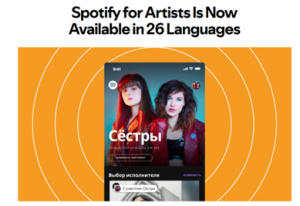
“Your Music. Your Fans. Your Language. More artists than ever can use their native languages to navigate Spotify for Artists.” Spotify web page
In addition, Spotify for Artists is now available in more languages to support even more artists, helping them build a community of followers in more places around the world.
Conclusion
These three examples of global brand localization show the importance of localizing your content and product to connect with your customers. In a global marketplace, we need to stop thinking of the translation and adaptation of content as a business expense, and start thinking of it as an investment. If we really want to sell in other countries, we have to localize our content to reach new customers there. It’s the only way to ensure our message reaches them clearly and to connect with our audience.
What about you? Do you want to be the next example of successful global brand localization?


