

Today, we are living in challenging times. Trends are changing fast in the world in general and in the language industry in particular. Artificial intelligence is seeping into all areas of our lives and work. How can we adapt and create opportunities to better help our clients?
Let’s start with some definitions related to Artificial Intelligence in the language industry:
Neural Machine Translation (NMT):
Neural machine translation (NMT) is a machine translation method based on artificial neural networks that has seen significant improvements in recent years. Before the advent of NMT, machine translation engines were based on statistical methods, which have more limitations and errors.
Machine Translation Post-Editing (MTPE):
Machine translation post-editing (MTPE) refers to the review of an automatically translated text (produced by an NMT engine) by a professional translator or specialized linguist. The translator’s job in the post-editing process is different from other types of revision because he or she has to take into account that the translation was done by Artificial Intelligence (AI), which is not always consistent and may make cultural and contextual mistakes.
Large Language Models (LLMs):
A large language model (LLM) is a giant statistical model that uses a large amount of data to produce content.
“An LLM is notable for its ability to achieve general-purpose language generation and other natural language processing tasks. LLMs are artificial neural networks. Some LLMs are private (OpenAI‘s ChatGPT) and others are Open Source.”*Source: Wikipedia
Prompt Engineering:
“Prompt engineering is the process of structuring text that can be interpreted and understood by a generative AI model. A prompt is natural language text describing the task that an Artificial Intelligence (AI) should perform.”*Source: Wikipedia
Examples of prompt engineering:
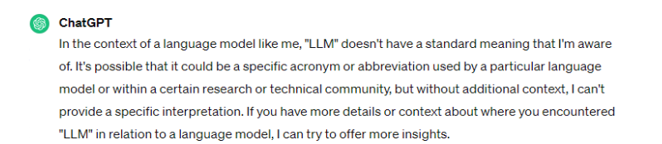
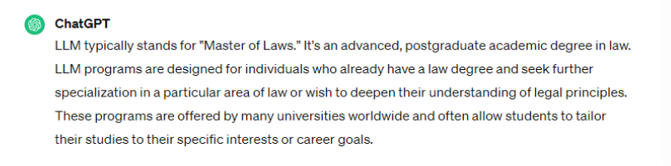
If we simply ask ChatGPT what an LLM is, it does not give us the expected answer. However, if we then give the LLM more context, it gets it right:
When we asked ChatGPT: “Tell me what an LLM is”, we got the following answer:
We then asked ChatGPT: “And in the context of a language model?” and we got the following answer:
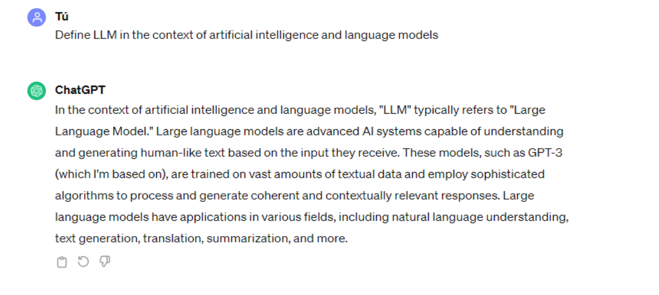
Alternatively, we can start by including more information in the initial prompt, which will result in a better response. This is called “prompt engineering”:
Generative AI:
“Generative artificial intelligence (generative AI, GenAI,or GAI) is artificial intelligence capable of generating text, images, videos, or other data using generative models, often in response to prompts.Generative AI models learn the patterns and structure of their input training data and then generate new data that has similar characteristics.”*
*Source: Wikipedia
Generative artificial intelligence plays a fundamental role in the generation of written content for blogs and articles[1]. By leveraging deep machine learning models, these AI systems can produce high-quality text based on user input and specific directions [2]. This capability allows content creators to streamline the writing process, saving time and maintaining creativity and consistency. For example, companies can produce informative articles, engaging blog posts, and even SEO-optimized content at an accelerated rate.
This not only improves productivity but also allows companies to maintain a consistent online presence, which is essential for audience engagement and brand awareness.
In addition to generating written content, generative artificial intelligence significantly improves the automation of social media posts and marketing materials [3]. With its ability to analyze user behavior and preferences, AI can create tailored content that resonates with target audiences, improving engagement rates [4].
Companies can use AI tools to schedule posts at optimal times, ensuring maximum visibility and interaction. This automation allows sellers to focus on strategy and creativity rather than the logistical aspects of content distribution. As a result, businesses can efficiently manage their social media presence, effectively reaching potential customers without the constant manual effort that is typically required.
In addition, generative artificial intelligence can be instrumental in creating personalized marketing campaigns that address individual customer needs [5]. By using AI techniques such as predictive analytics and customer segmentation, companies can analyze extensive datasets to identify user patterns and trends [5].
This information allows companies to create highly targeted ads and promotional materials that resonate with specific demographics. As a result, sellers can test multiple versions of an ad in near real-time, optimizing campaign performance based on immediate feedback [6]. With these personalized approaches, companies not only improve customer satisfaction, but also increase conversion rates and build brand loyalty.
Benefits and limitations of generative artificial intelligence
Benefits:
- Enhanced creativity: Generative AI can help us by providing inspiration, generating new ideas, and even creating draft versions of content, making the creative process more efficient.
- Automated content generation: Companies can leverage generative AI to produce draft marketing materials, draft reports, and draft social media posts faster, improving productivity and allowing teams to focus on strategy and analysis rather than repetitive tasks.
- Personalized user experiences: Generative AI can analyze user data to create tailored recommendations, content, or services, improving the user experience and increasing customer satisfaction and engagement.
- Rapid prototyping: In product design and development, generative AI can quickly generate multiple design iterations, allowing teams to explore more concepts in less time and ultimately lead to better products.
- Enhanced data analytics: Generative AI can examine large amounts of data to identify patterns and generate insights, helping companies in decision-making processes and enabling more informed strategies.
Limitations:
- Quality control issues: While generative AI can produce content quickly, quality can vary, leading to the need for human editing and supervision, which can offset some efficiency gains.
- Bias and Ethical Concerns: Generative AI models can inadvertently perpetuate biases present in their training data, posing ethical dilemmas and potentially leading to harmful outcomes if not properly managed.
- Technical Experience Required: Effective implementation and use of generative AI solutions often requires specialized knowledge, which may require additional training or recruitment of qualified personnel.
- Implementation costs: Developing and deploying generative AI solutions can be expensive, requiring significant investment in technology and resources, which may not be feasible for all organizations.
- Learning curve: Users may face challenges in understanding how to effectively leverage generative AI tools, leading to a steep learning curve that can hinder immediate benefits.
Solutions:
- Establish quality assurance processes: Organizations can implement review and editing processes to ensure that generative AI production meets quality standards, thereby mitigating concerns about content quality.
- Investing in training programs: Providing training sessions and resources for employees can bridge the knowledge gap and enable users to use generative AI effectively and efficiently.
- Budget planning: Organizations should carefully assess the costs and benefits of implementing generative AI, exploring funding options or phased implementation to spread costs over time.
- Easy-to-use tools: Look for generative AI solutions designed with user experience in mind, with intuitive interfaces and support resources that facilitate the learning curve.
Let’s look at some of the features of LLMs:
- They are based on millions of segments.
- They can be combined with translation memories (TMs) and machine translation (MT) + a glossary to make decisions based on all these resources.
- They give translators more options, meaning the crux of the review task is the human choice, the most powerful part of the translation process.
- You can use natural language to interact with them.
- There are different LLM usage levels:
- Prompt engineering (not customizable)
- LLM model finetuning with Python (open-source models)
- Creating your own LLM
Now that we understand what LLMs are and how they work, let’s look at some examples of real use cases they can be used for:
- Glossary creation: They can be used to extract terms from a text that can later be added to a glossary. They can even add a definition for each term.
- Restructuring .srt files (for subtitles): They can convert segmented lines to real sentences in .srt files so that CAT tools can process them properly.
- Language quality assurance (LQA): They can analyze text and perform QA in different languages.
LLMs thus offer many benefits for the language industry, but there are caveats:
- There are around 7,000 languages in the world, but LLMs are only trained in about 20 of them, mainly English, meaning there is still a long way to go.
- LLMs can make mistakes, so it is paramount for subject matter experts to review the information they generate.
- Depending on which LLM we use, we may need to bear in mind that any information we upload will be used to train it, and confidential information will be lost.
Conclusion
Generative AI has numerous advantages, including enhanced creativity, automated content generation, customized user experiences, rapid prototyping, and enhanced data analysis. However, it also poses limitations such as quality control issues, bias and ethical concerns, technical expertise requirements, implementation costs, and learning curves. By establishing quality assurance processes, investing in training, ensuring diverse training data, and selecting easy-to-use tools, organizations can address these challenges and maximize the benefits of generative AI. Ultimately, a balanced approach allows users to make informed decisions about adopting and integrating generative AI into their workflows.
We should become experts in AI to help our clients implement it in their processes. We have to learn how to use NMT, LLMs, and any other Artificial Intelligence (AI) tool that can make us more productive, reduce costs, and help our clients, depending on their needs.
If you want to know how to implement AI in your processes, email us, and we will analyze your project. It will be a pleasure to help you.
References
1.Controlled use of generative artificial intelligence to …. (n.d.) Retrieved January 13, 2025, from http://formaciooberta.eapc.gencat.cat
2. 5 examples of artificial intelligence in 5 business sectors. (n.d.) Retrieved January 13, 2025, from http://blog.bismart.com/ca/intelligencia-artificial-5-exemples
3. Everything you need to know about artificial intelligence. (n.d.) Retrieved January 13, 2025, from http://landing.bismart.com/ca/intelligencia-artificial
4. Artificial Intelligence in social networks. (n.d.) Retrieved January 13, 2025, from http://www.undatia.es
5. Artificial intelligence in marketing? What the future of … will look like. (n.d.) Retrieved January 13, 2025, from http://www.idisc.com/ca/blog/intelligencia-artificial-en-marketing
6. The impact of generative artificial intelligence on the …. (n.d.) Retrieved January 13, 2025, from http://creandgroup.com
7. The importance of chatbots in customer experience before…. (n.d.) Retrieved January 13, 2025, from http://iartificial.blog
8. Top 5 Benefits of AI Chat Bots in Healing …. (n.d.) Retrieved January 13, 2025, from http://enreach.es
9. 6 uses of Artificial Intelligence to improve care …. (n.d.) Retrieved January 13, 2025, from http://vertical-iberica.com
10. The role of artificial intelligence in companies. (n.d.) Retrieved January 13, 2025, from http://blog.bismart.com
11. 6 benefits of artificial intelligence in the management of …. (n.d.) Retrieved January 13, 2025, from http://blogs.uoc.edu
12. Tools to generate images and music. (n.d.) Retrieved January 13, 2025, from http://moodle2023-24.ua.es
13. Artificial intelligence in music is a tool or …. (n.d.) Retrieved January 13, 2025, from http://www.enderrock.cat


